A small rental kitchen can feel crowded long before it runs out of storage, and spices are a classic example: you use them often, but a drawer of small jars is hard to scan and counter jars add clutter.
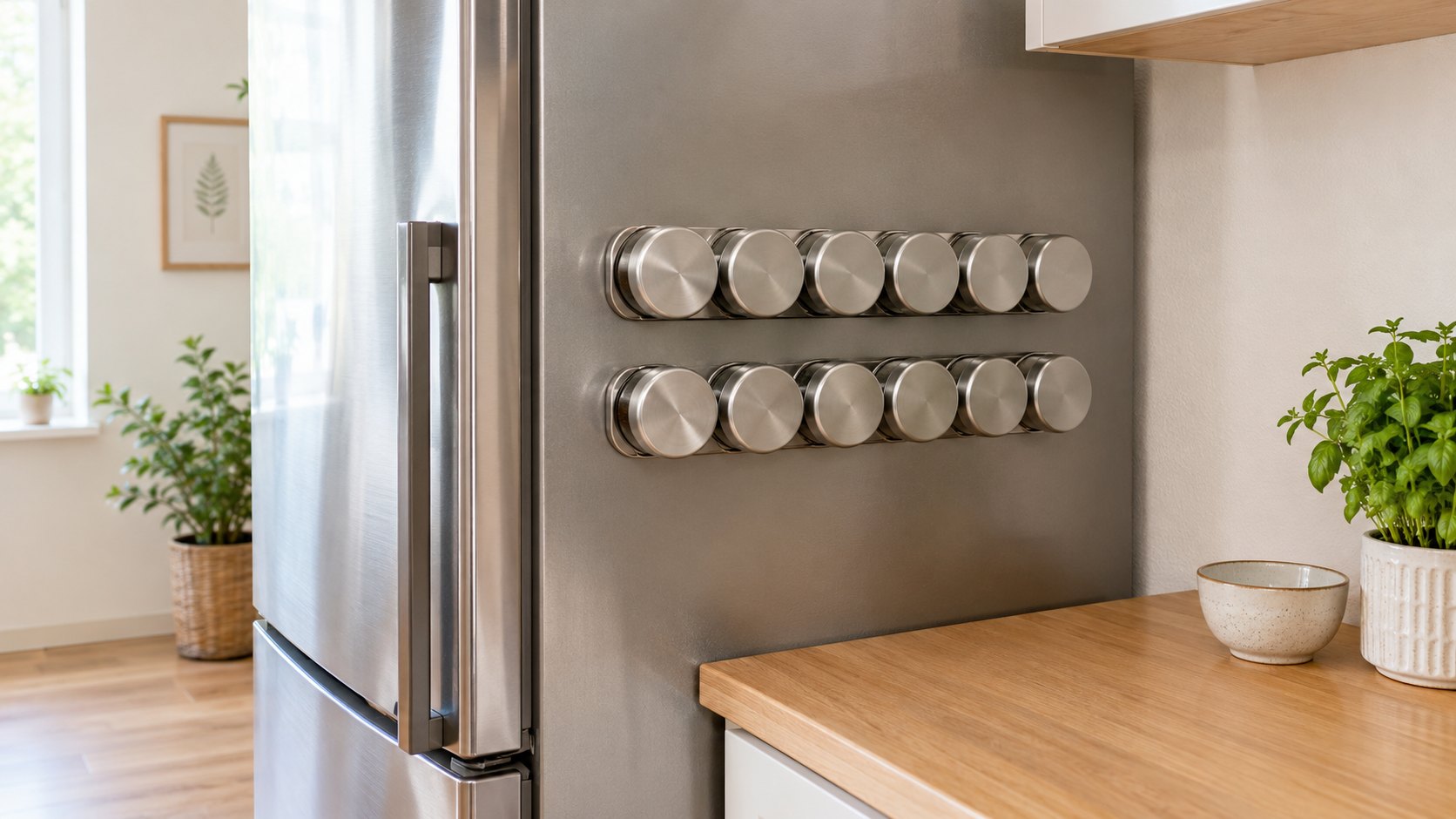
A magnetic rack can fix that without a drill, as in the cover photo. But it is a small storage system with three conditions: the surface has to be magnetic, the load has to stay within the rack’s limit and the spices have to be kept away from heat. This guide checks each condition in that order, then shows how to lay out one or two rows.
1. Test the Surface First
Do not buy the rack first. Many refrigerators that look like steel do not hold magnets, and the result can differ across the same appliance.
Stainless steel comes in different types. Hunker explains that ferritic stainless steel is magnetic, while austenitic stainless steel typically is not. It also notes that a thin steel skin over a magnetic core can still hold a strong magnet, and that a magnet may stick to the side of a refrigerator but not the door.
The practical rule is to test with a strong magnet, or with the rack itself if the store allows returns, at each spot where you might mount it.
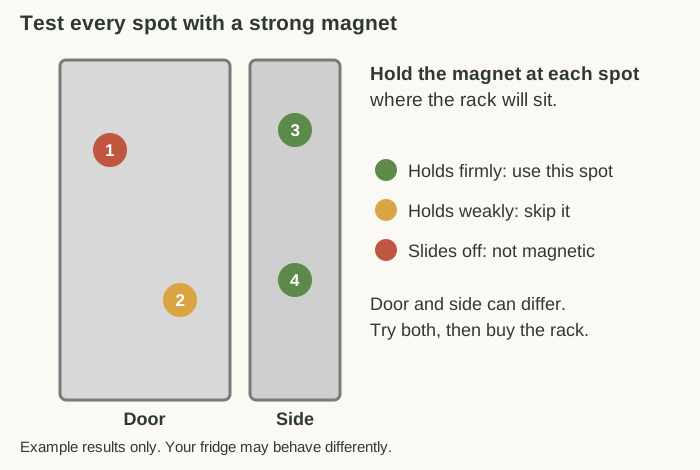
Mark spots that hold firmly with painter’s tape, then measure the usable space between them: width, height and the distance to the door edge, so the door still opens.
2. Check the Load Before You Buy
Small tins look light until you fill and multiply them. Do a quick weight check:
- Weigh one filled tin on a kitchen scale.
- Multiply by the number of tins you plan to mount.
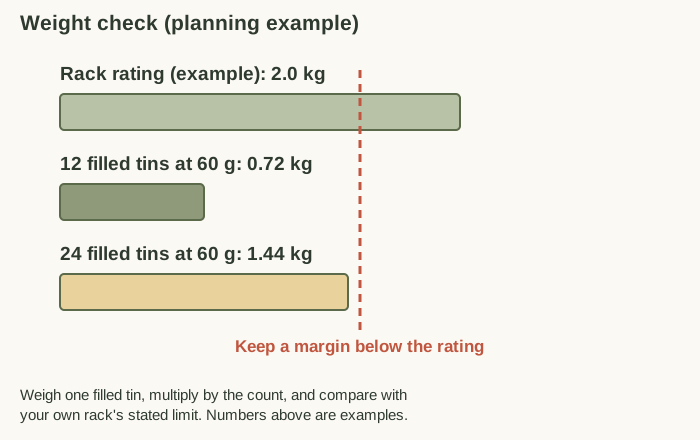
- Compare the total with the rack’s stated limit, and keep a margin below it.
The diagram uses example numbers: a rack rated for 2.0 kilograms, with 12 tins at 60 grams each weighing 0.72 kilograms.
If you want more tins than the rack can carry safely, use two racks or move the occasional spices to a cabinet. Do not rely on a magnet that barely holds an empty rack.
3. Keep Spices Away From Heat and Steam
UF/IFAS Extension says dried herbs and spices never actually spoil, but flavor and aroma fade over time. It advises storing them in a cool, dry place in tight containers and away from heat, and keeping the container away from steaming pots while cooking.
That makes the position matter as much as the surface:
- Choose the fridge side farthest from the range. A rack next to the cooktop gets heat and steam.
- Think about fire safety too. NFPA advises keeping anything that can catch fire, including food packaging, away from your stovetop.
- Check the spot by hand. If the fridge side feels warm, pick another surface.
- Keep the door path clear. Tins should not be hit when the door opens.
4. Plan One Row or Two
Spices you grab daily belong where your hand goes naturally. The ADA Standards describe an unobstructed forward reach of 15 to 48 inches above the floor. Your kitchen does not have to meet that rule, but it is a handy comfort range.
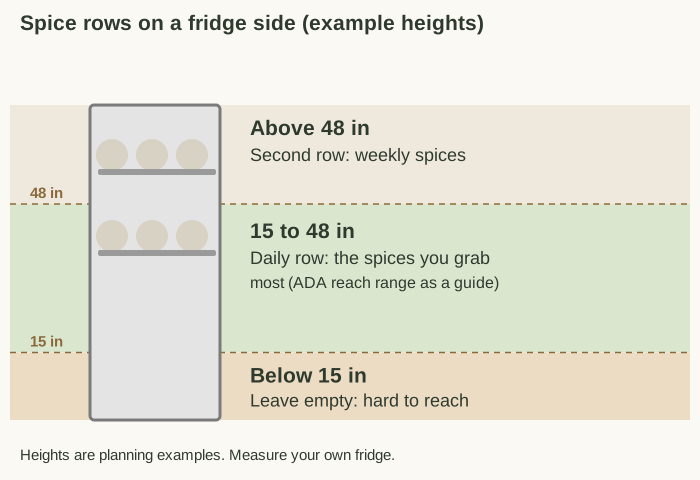
- Daily row inside the 15 to 48 inch band, for the spices you use most.
- Second row above it, for weekly spices.
- Nothing low. Items below 15 inches are awkward to reach and easy to knock.
Start with one row. Add a second only when the first is full and the surface still holds firmly.
5. Choose Tins and Labels
The cover photo uses round tins with clear lids, which lets you see the contents at a glance. Whatever style you choose:
- Use tight lids. UF/IFAS recommends tight containers.
- Match the size. Equal tins line up neatly and make the load predictable.
- Label the lid and the side. You can read the label from above and from the front.
- Write the date. Large-flake herbs such as basil and oregano stay fresh for one to three years, and ground spices such as paprika for two to three, according to UF/IFAS.
- Use one language on every label. Consistent labels are easier to scan.
6. Order the Tins
Arrange tins by use, not by the alphabet:
- Daily spices in the middle of the row, at hand height.
- Weekly spices on the next row or the ends.
- Spices for one recipe in a cabinet.
Two rules prevent chaos: one spice per tin, and one tin per space. If a tin has no place, it either goes in the cabinet or leaves the kitchen.
7. Protect the Fridge and Your Deposit
- Slide magnets slowly rather than dragging them, and avoid sharp-cornered ones that can scratch the finish.
- Wipe the surface before mounting, and wipe behind the rack when you clean.
- Take the rack off before moving out and check the surface.
- If the fridge belongs to the landlord, treat it like any other fixture.
8. If Nothing Is Magnetic
Not every kitchen has a magnetic surface. Options include:
- A thin steel sheet or magnetic board mounted with removable adhesive, within the adhesive’s rated load. See our adhesive hook guide for how to apply removable strips correctly.
- The inside of a cabinet door, if the door and hinges can carry the load.
- A pull-out spice tray, as in our galley kitchen guide .
9. Mistakes to Avoid
- Buying before testing. The rack is useless if the surface does not hold.
- Ignoring weight. Fill a tin and weigh it first.
- Mounting beside the range. Heat and steam shorten the life of spices.
- Overloading the second row. One firm row is better than two sagging ones.
- Mixing tin sizes. It looks messy and makes the load harder to predict.
- Forgetting the exit. Know how you will remove it.
10. A 10-Minute Setup
These times are planning estimates.
- Test (2 minutes). Check door and side with a strong magnet.
- Weigh (2 minutes). One filled tin times the count, against the rack’s limit.
- Fill and label (4 minutes). Decant, add the name and date.
- Mount (1 minute). Place the daily row in the reach band.
- Check (1 minute). Open the door, tap the rack, confirm nothing slides.
For more small-kitchen ideas, see our small kitchen guide , the guide to kitchens without a pantry and the renter kitchen storage ideas .
Frequently Asked Questions
Can I use a magnetic spice rack in a rental kitchen?
Yes, if it holds by magnets and needs no drilling, and if the surface is magnetic. Test the exact spot first, and check that the appliance is not something you will be charged for if it gets scratched. Remove it before you move out.
Will a magnet stick to my stainless steel fridge?
It depends. Ferritic stainless steel is magnetic, while austenitic stainless steel typically is not, and a thin steel skin over a magnetic core can still hold a strong magnet. Hunker notes that a magnet may stick to the side of a refrigerator but not the door, so test both before you buy a rack.
How many tins fit on a fridge side?
It depends on the width of the side and the size of the tins. The cover photo shows twelve tins in two rows. Measure the width, leave room for the door to open and for your hand, and load the rack only up to its stated limit.
How do I stop magnetic tins from sliding?
Keep the load light, use a rack rated for the weight, wipe the surface before mounting and avoid placing it on a surface that only holds weakly. If a rack drifts down, remove some tins or move it to a surface that holds more firmly.
Is the side of a fridge a good place for spices?
UF/IFAS Extension advises storing herbs and spices in a cool, dry place in tight containers, away from heat. Check by hand that the spot is not warm, and choose the side farthest from the range.
What if my kitchen has no magnetic surface?
Mount a thin steel sheet or a magnetic board with removable adhesive within its rated load, or use an inside cabinet door. Our galley kitchen guide shows a pull-out spice tray as a non-magnetic alternative.
Sources
- UF/IFAS Extension, Shopping for Health: Herbs and Spices (PDF) : store dried herbs and spices in a cool, dry place in tight containers, away from heat and steaming pots, with typical storage times for herbs and ground spices.
- Hunker, Do Magnets Stick to Stainless Steel? : ferritic versus austenitic stainless steel, thin steel skins over magnetic cores, and magnets that stick to the side but not the door.
- NFPA, Cooking Safety : keep anything that can catch fire, including food packaging, away from the stovetop.
- US Access Board, ADA Chapter 3: Operable Parts : the 15 to 48 inch unobstructed forward reach range.
The diagrams are original illustrations made for this guide. Weights, rack ratings and heights are planning examples, so test your own surface and follow the rack manufacturer’s stated limit.
Image Credits
- Cover: AI-generated image via ChatGPT, October 2026.