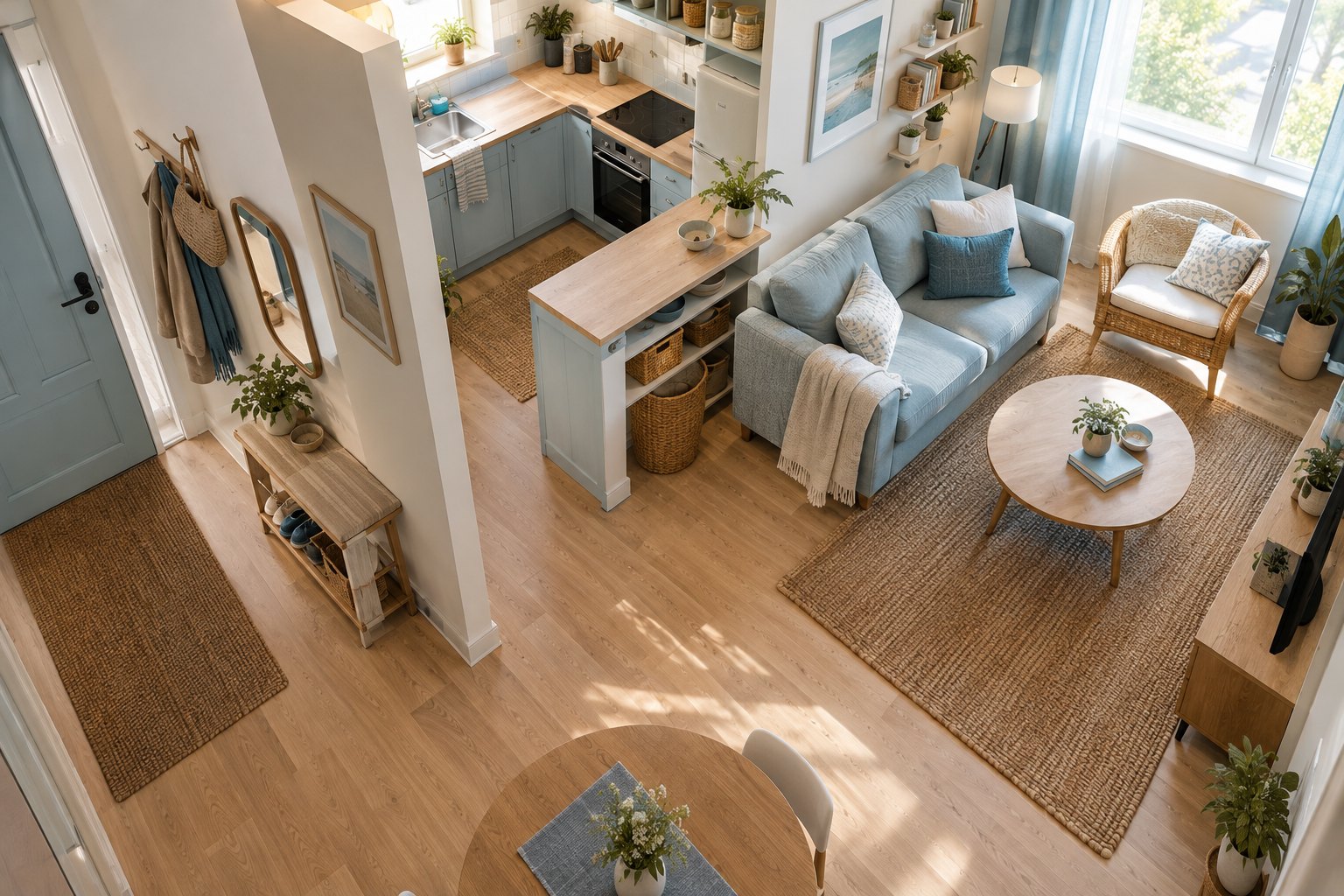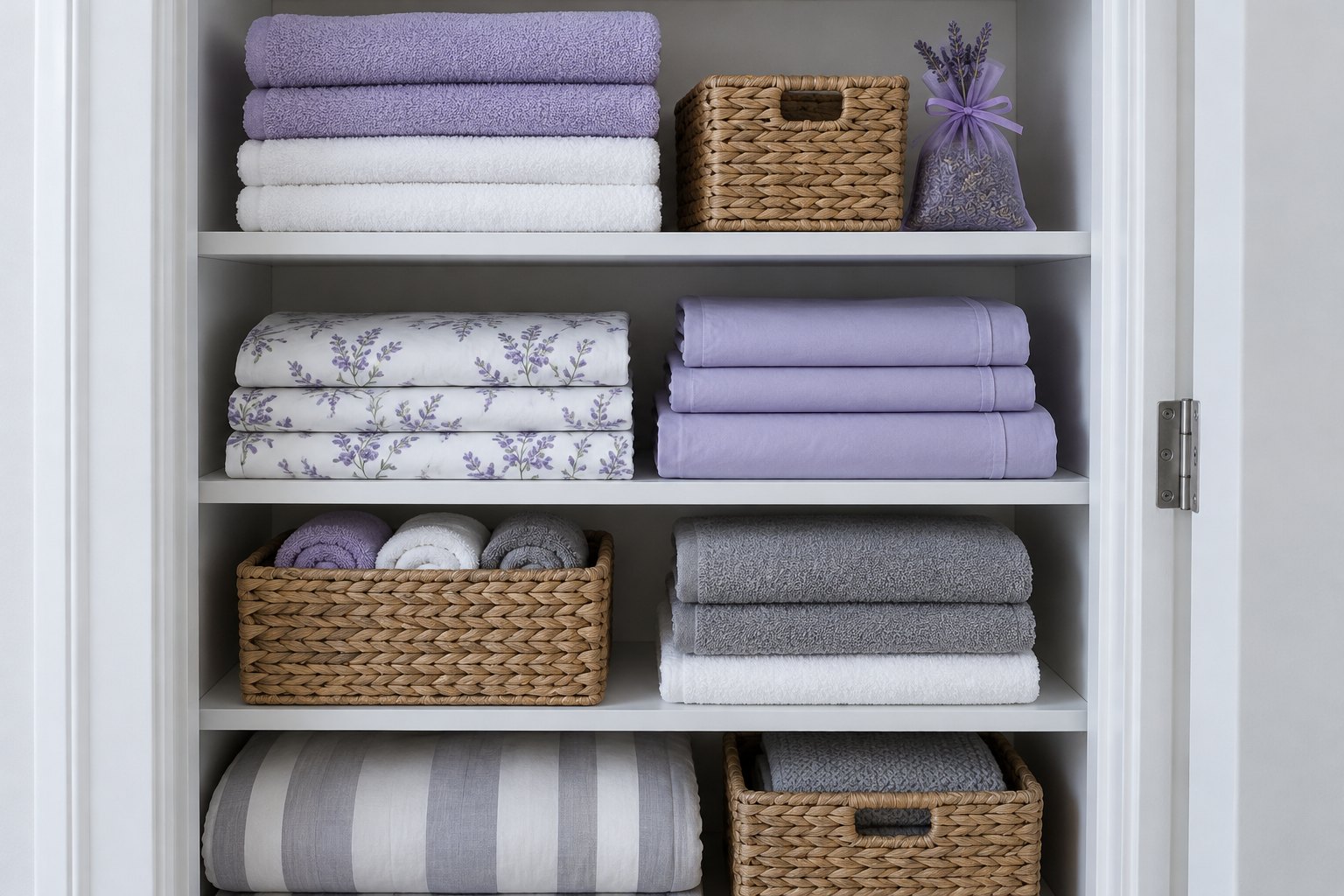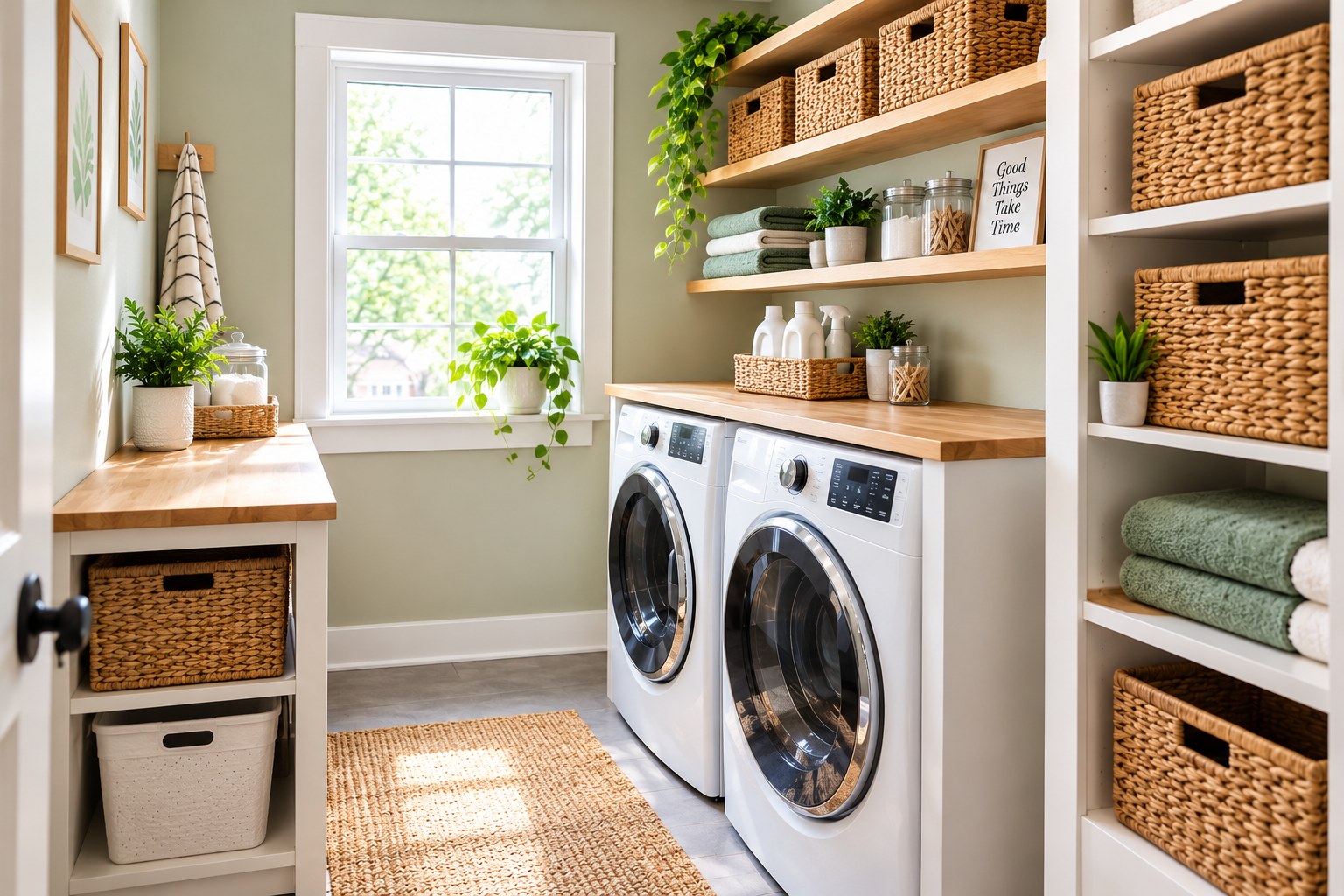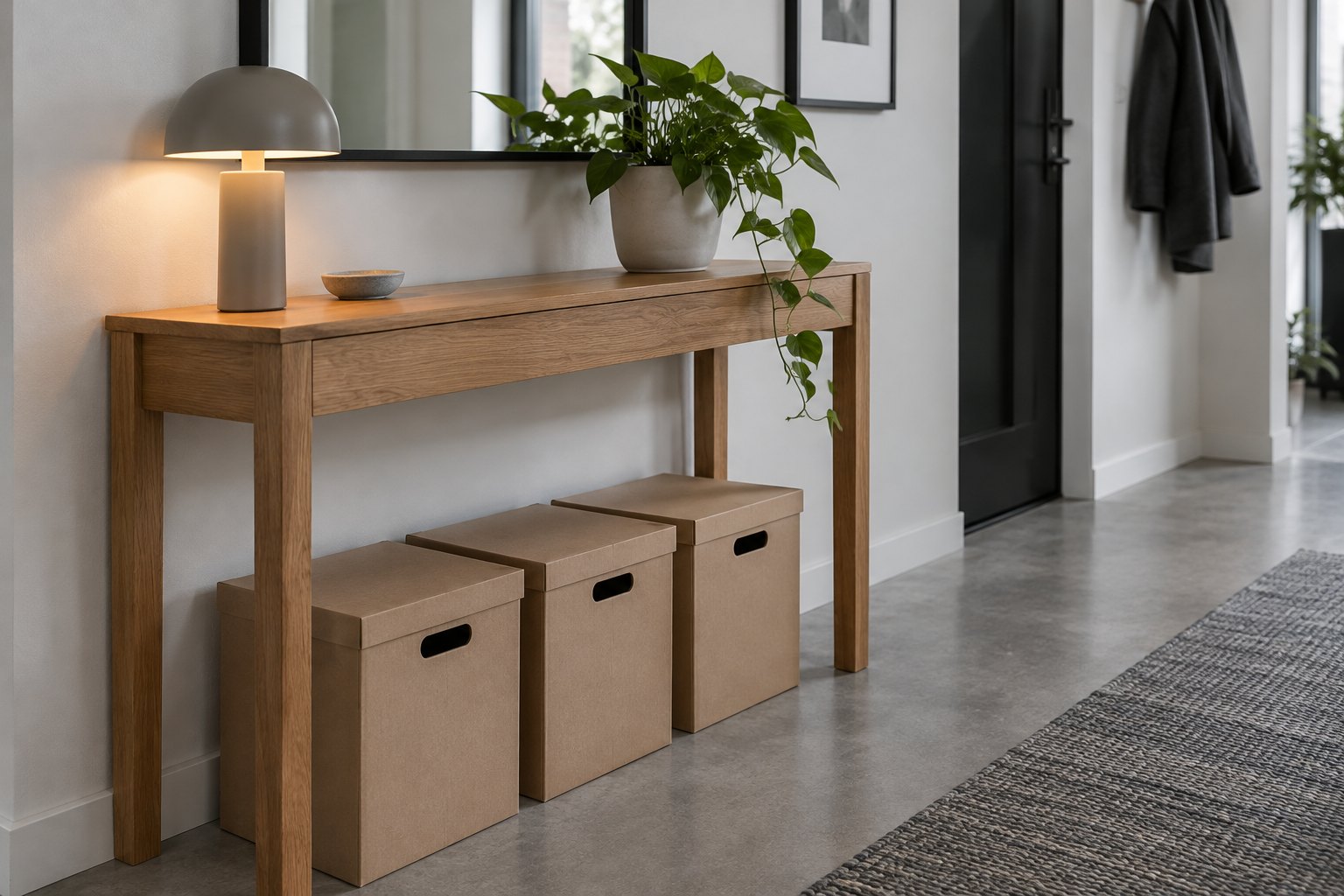
A small home does not need more storage every time it feels crowded. Often, the practical problem is that too many items have no clear home, a category has no physical limit, or putting something away takes more effort than leaving it out.
The most useful decluttering ideas for small homes therefore do two jobs: remove things you do not need and make the things you keep easier to manage. This guide is designed for a real home, not a one-day makeover. You can test the system without emptying every cabinet, buying a matching set of containers, or creating piles in every room.
Start With a 15-Minute Decluttering Audit
Do not begin by pulling everything out of a closet. That can create a larger mess before you know what problem you are solving.
Instead, walk through the home for 15 minutes with a phone note or sheet of paper. Mark the places where clutter repeatedly appears:
- a kitchen counter that fills up every evening
- a chair that becomes a clothes pile
- an entryway where keys, mail, and bags collect
- a drawer that cannot close easily
- a bathroom shelf containing products you rarely use
- a cabinet where you move several items just to reach one
Then choose one problem area. Do not solve five areas at once.
Use four decisions: keep, relocate, donate, and discard/recycle. Relocate deserves its own category because an item can be useful while still being stored badly.
For example, if scissors always end up on the dining table, the problem may not be the scissors. Their drawer may simply be too far away. Moving them closer to where they are used can prevent the same clutter from returning.
The goal of the first audit is not a perfect home. It is to identify the small number of locations causing most of the daily mess. Write down what you see before changing anything. That gives you a simple baseline for checking whether the solution actually works.
Declutter One Category at a Time
Random piles make decluttering harder because you are making decisions about unrelated objects at the same time.
Choose one category: mugs, cables, toiletries, clothing, papers, food containers, or cleaning supplies. Gather only that category and compare similar items together. If the category is large, split it into a smaller group such as everyday mugs, winter clothing, or bathroom backups.
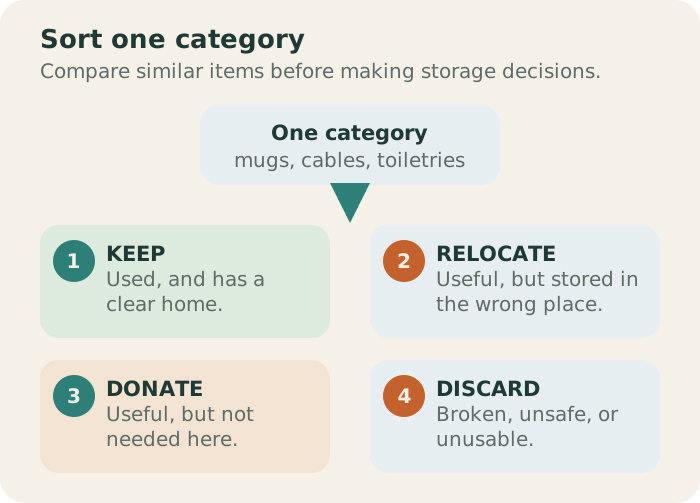
For each item, ask:
- Do I use it?
- Would I replace it if it disappeared?
- Does it justify the space it occupies?
- Do I already own something that does the same job?
- If I keep it, where will it live?
That fifth question prevents a common failure: keeping an item without deciding where it belongs.
The third question is especially important in a small home. An item can be useful and still be one of five versions of the same thing.
Food containers are a practical example. If a cabinet comfortably holds 12 containers and you own 25, the solution is not necessarily a larger cabinet. Set a realistic limit, keep the pieces you actually use, and let the available space define the collection. Match lids with containers while you are sorting; unmatched pieces should not occupy prime storage space indefinitely.
Avoid creating a whole-house “maybe” pile. If a decision is difficult, place only a small number of uncertain items in a dated box. Write the review date on it and keep it out of the main living area. Review it later rather than allowing an unfinished project to occupy your home.
For household items that can be reused or recycled, the U.S. EPA describes reduction and reuse as the most effective ways to save natural resources, so consider them before recycling; see its archived reducing and reusing guidance .
Give Everyday Items a Home Near Where You Use Them
A storage system works when it matches your real routine.
If you use your charging cable beside the sofa every night, storing it across the room creates unnecessary friction. If you always remove your shoes at the entrance, shoe storage belongs there rather than in a bedroom closet.
Try this rule: store frequent-use items within easy reach and occasional items farther away.
For example:
- everyday shoes near the entrance
- cooking tools near the food-preparation area
- cleaning cloths near the rooms where they are used
- chargers near the devices they serve
- seasonal clothing on higher or less convenient shelves
- spare toiletries together instead of mixed with daily-use products
You do not need labels for everything. You need a location that is obvious enough that you can put an item away without stopping to decide where it belongs.
If an item repeatedly lands on the same surface, treat that as useful information. Either give it a proper home there or move its storage closer to the routine that uses it.
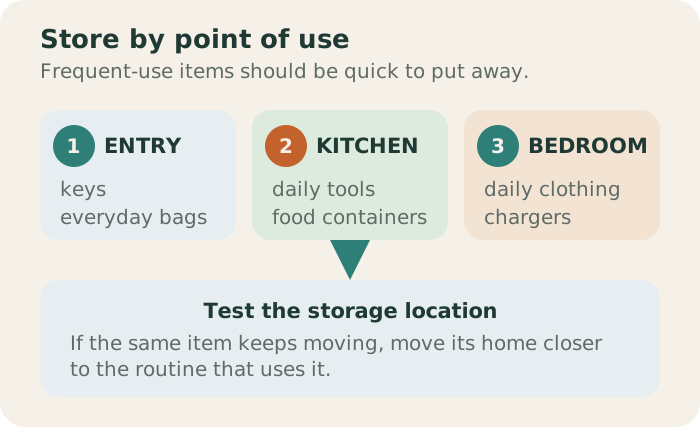
This zone-first approach is particularly useful in small homes because it reduces unnecessary movement. If the same category keeps traveling from room to room, the storage location is probably fighting the way you use the space.
For a compact closet, you can apply the same principle with the small closet organization guide . For a bedroom with limited floor area, the small bedroom storage guide can help you turn unused or awkward areas into practical storage without making the room harder to use.
Set Physical Limits for Problem Categories
A decluttering rule becomes much easier to follow when it has a physical boundary.
Instead of saying “I should not have too many bags,” choose one shelf, drawer, hook section, or basket for them. When the space is full, the boundary tells you that something needs to leave before another item comes in.
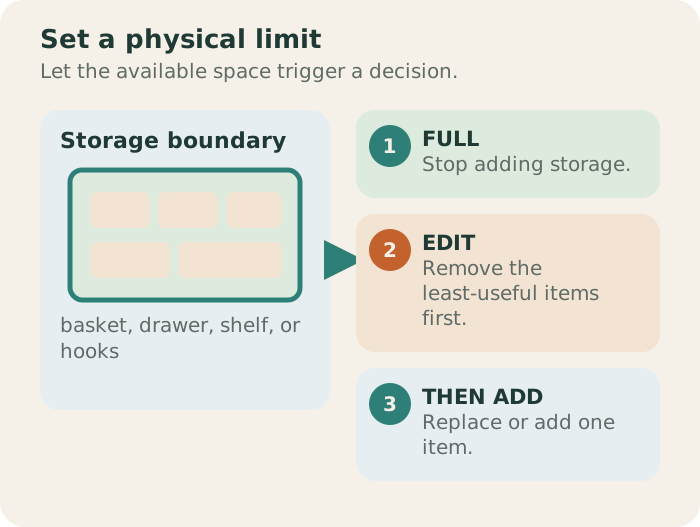
This works well for:
- reusable shopping bags
- mugs and water bottles
- towels
- toiletries
- cables
- cleaning products
- seasonal accessories
- food containers
The limit should reflect actual use. A household that regularly hosts guests may need more towels than a household that does not. The point is not to force an arbitrary number; it is to stop a category from expanding without a decision.
Use the container, shelf, drawer, or hook area as the limit rather than adding another storage layer every time the category grows. If a basket is full, first ask whether the contents need editing. If the answer is yes, remove the least useful items before buying a second basket.
This is also why buying storage containers too early can backfire. A larger container can hide the fact that you already own more than the room can comfortably support. Declutter first, measure second, buy storage last.
Turn High-Clutter Surfaces Into Controlled Zones
Kitchen counters, desks, dining tables, bedside tables, and entryway furniture attract objects because they are convenient.
Instead of trying to keep every surface completely empty, define what is allowed to live there.
For example:
Entryway: keys, one everyday bag, and a small mail tray.
Desk: current work, one notebook, and the equipment used every day.
Kitchen counter: only appliances used frequently.
Bedside table: lamp, current book, and a few daily essentials.
A tray can help contain legitimate everyday items. But the tray should have a limit too. If it becomes an overflowing box of unrelated objects, it has stopped solving the problem.
Use a two-question surface check at the end of the day: “Does this belong here?” and “Will I need it here tomorrow?” If the answer to both is no, return the item to its home.
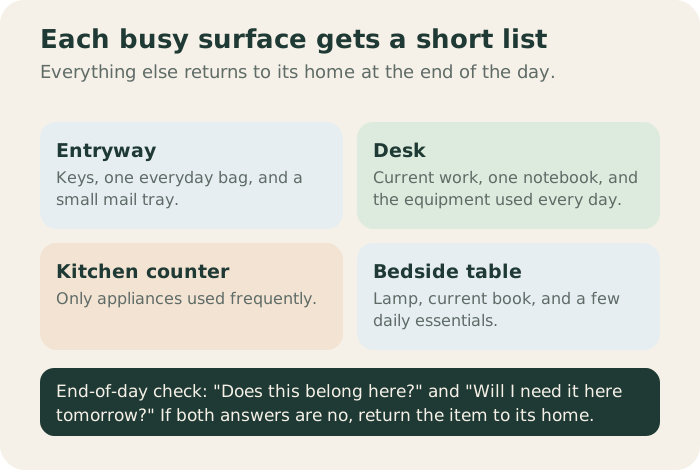
The same principle works for a narrow hallway. If you are struggling with a tight entrance, a small designated drop zone can be more useful than adding a large cabinet. The narrow entryway organization guide shows how to make a small arrival zone practical without allowing it to become a dumping area.
Make Small Closets Easier to See and Reach
A closet can hold a surprising amount while still being difficult to use. The warning signs are simple: you cannot see what is behind the front row, you have to remove several items to reach one thing, or folded stacks collapse whenever you take something out.
Start by removing items that belong somewhere else. Then group what remains by type and frequency of use.
Keep everyday clothing at comfortable reach height. Move seasonal or occasional items to less convenient shelves. Avoid containers so deep that you have to unload them to reach the bottom.
Before buying an organizer, measure:
- usable width
- usable depth
- shelf height
- door clearance
- hanging height
- clearance needed to open drawers or doors fully
A container that fits the shelf width can still be a bad choice if it blocks the door or makes the back of the shelf inaccessible.
Leave some empty space as working room. A closet filled to 100 percent capacity may look efficient, but it usually becomes harder to maintain because every item requires extra handling.
Do not solve a visibility problem by simply adding labels or stacking more containers. First make sure the things you use most often are physically easiest to reach.
Create a Landing Zone for Mail, Bags, and Keys
The entrance is where outside clutter enters the home. Without a simple transition point, mail, bags, shoes, receipts, and keys can spread into several rooms.
Create three clear destinations:
- Mail: one tray or folder for unopened and pending paper
- Keys: one hook, bowl, or small tray
- Bags: one defined shelf, basket, or hook area
Keep the system close to the door and make it possible to use it in seconds.
Paper needs a second step. Decide where important documents go, where pending paperwork waits, and where recycling happens. A permanent “deal with later” pile is not a system because it has no decision point. Give pending paper a review point such as a specific day each week.
For reusable bags, use the space available as the limit. If the bag basket is full, remove extras instead of finding another basket.
The landing zone should also have a clear exit. When mail is finished, it should go to recycling, filing, or an action location. When a bag is unpacked, it should return to its defined storage space.
Choose a Clear Exit Route for Unwanted Items
Decluttering does not finish when an item leaves a shelf. Decide where each unwanted item goes so bags and boxes do not become a new form of clutter.
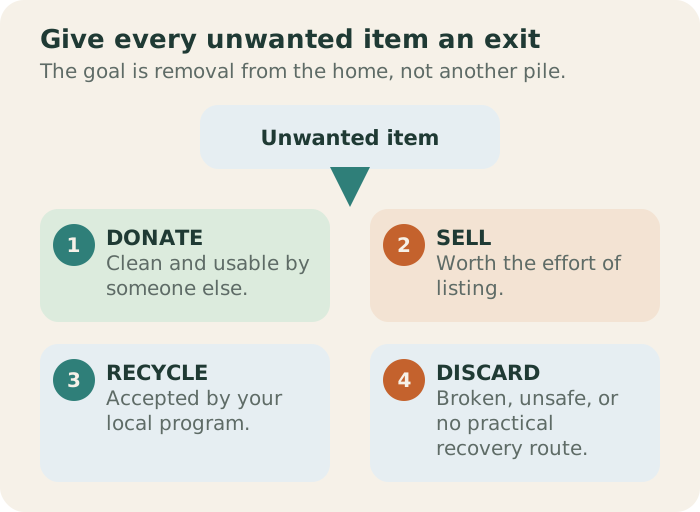
Use a simple route:
- Donate: clean, usable items that someone else can reasonably use.
- Sell: items worth the time and effort of listing them.
- Recycle: materials accepted by your local recycling program.
- Discard: broken, unsafe, or unusable items that have no practical recovery route.
Keep outgoing items in one temporary location and set a short deadline for moving them out of the home. This prevents a “donation pile” from becoming permanent storage.
For recycling, check the rules of your local program rather than assuming every plastic, package, cable, or household object belongs in the recycling bin. The EPA explains basic recycling principles and why accepted materials depend on local systems in its recycling basics guide .
Some household products need a different route. Paints, cleaners, oils, batteries, pesticides, and other potentially hazardous household products should not automatically go into ordinary trash or recycling. The EPA’s household hazardous waste guidance explains the category and safe disposal considerations.
The objective is not to make the entrance look perfect all day. It is to prevent a five-minute arrival routine from creating a 30-minute cleanup later.
Remove Unnecessary Furniture Before Buying More Storage
When a small room feels crowded, adding storage can make the problem worse.
Walk through the room and identify furniture that has become a storage surface rather than serving its original purpose. An unused chair covered with clothes, a side table permanently covered with papers, or a cabinet filled with forgotten items may be consuming valuable floor space.
Test one questionable piece of furniture for a few days if you can safely move it aside. Pay attention to:
- walking paths
- cleaning access
- whether the room feels easier to use
- whether you actually miss the furniture’s function
- whether another item has taken over the same job
Only after this test should you decide whether additional storage is necessary.
When storage really is needed, prefer solutions that match the available footprint. A narrow vertical cabinet may work better than a wide unit in a tight room. Under-bed storage can be useful for seasonal items, but only if the containers remain accessible and you do not need to move several unrelated objects to reach them.
The goal is not maximum storage. It is enough storage that is easy to use.
Use the One-In, One-Out Rule Selectively
The one-in, one-out rule can prevent gradual clutter, but it should not be applied blindly.
It works particularly well for categories where you already have a clear limit, such as mugs, towels, everyday clothing, containers, or duplicate tools.
Before buying a replacement, ask:
- Where will the new item live?
- What does it replace?
- Is the old item still useful?
- Do I already own something that performs the same job?
- Will the new item force another category out of its space?
If you cannot answer where the new item will live, that is a useful reason to pause before buying it.
Do not use the rule for every category. Some items need backups for practical reasons, and a new object can have a genuinely different purpose. The useful idea is to make new possessions compete with the limited space you actually have.
Build a Ten-Minute Reset Instead of Reorganizing Every Day
Decluttering is easier to maintain when the daily cleanup is short.
Set a timer for ten minutes. Start with visible clutter and work in the same order each time:
- return misplaced items
- clear one high-traffic surface
- put away clothing
- process obvious rubbish and recycling
- return everyday items to their homes
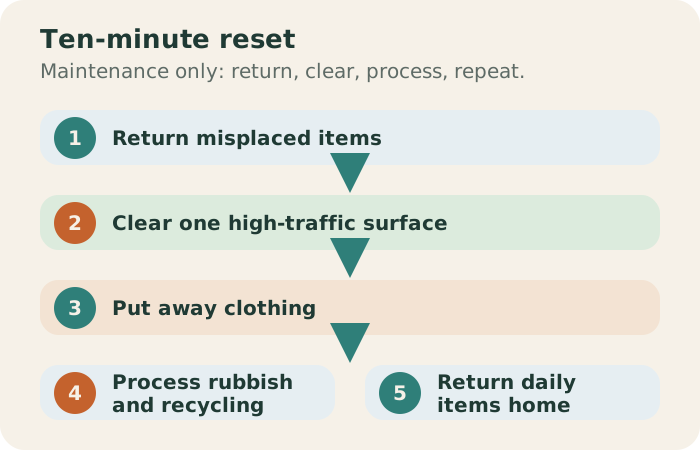
Do not start a new organizing project during the reset. The reset is maintenance, not another decluttering session.
Once a week, inspect the area where clutter returned most quickly. If the same objects repeatedly need to be moved, do not simply try harder. Ask what the repetition is telling you.
Maybe the storage location is too far away. Maybe the container is awkward. Maybe the category contains more items than the available space can support. Maybe the item does not actually have a home.
Change the system rather than depending entirely on willpower.
Give Each Room One Simple Maintenance Rule
Finish by choosing one rule for each room that has a recurring clutter problem.
Examples:
- Bedroom: clothes do not live on the chair.
- Kitchen: the counter holds only daily-use appliances.
- Entryway: mail is processed before it reaches another room.
- Bathroom: expired or unused products leave when the storage area reaches its limit.
- Desk: finished papers leave the work surface at the end of the day.
Keep the rule specific enough to guide a real decision. “Keep the room tidy” is too vague. “Only current work stays on the desk overnight” is checkable.
After two weeks, review it. If it makes daily life easier, keep it. If it creates constant friction, change the system rather than blaming yourself for not following it.
A small home also benefits from intentionally empty space. An uncrowded drawer, clear corner, or partly empty shelf is not wasted capacity. It gives you room to put things away, handle temporary changes, and notice when a category is growing again.
Connect Your Decluttering System to the Rest of the Home
Decluttering works better when each room supports the next one. If the entrance has a clear landing zone, the bedroom has a defined clothing limit, and the kitchen has boundaries for containers and appliances, fewer items migrate into random piles.
For a closet problem, continue with our small closet organization guide . For a bedroom that needs more usable storage, use the small bedroom storage guide . If the bathroom is the recurring problem area, see the small bathroom organization guide . For a compact kitchen, use the small kitchen organization guide .
The useful test is simple: after you declutter, can a normal person in the household put an item away quickly without asking where it belongs? Can the category stay inside its physical limit? Can unwanted items leave the house without becoming a new pile?
If the answer is yes, the system is doing its job. You do not need every surface to look like a staged room. You need fewer repeated decisions and fewer objects fighting for the same limited space.
Frequently Asked Questions
How do I start decluttering a small home without making a bigger mess?
Start with one visible problem area and a 15-minute timer. Remove rubbish and obvious duplicates first, then finish one small category before moving elsewhere.
What should I get rid of first?
Start with rubbish, broken items, obvious duplicates, and things you would not replace if they disappeared. Save sentimental decisions for later, when you have more space and less visual noise.
Should I buy storage containers before decluttering?
Usually no. Declutter first, measure the space that remains, and then choose containers that fit the actual shelf, drawer, or cabinet.
How can I stop clutter from coming back?
Give frequently used items simple homes, set physical limits for problem categories, control new purchases, and use a short daily reset. If the same clutter returns, change the system that produced it.
What if I feel attached to too many things?
Work slowly and keep meaningful items together. Give sentimental belongings a defined amount of space instead of trying to make every decision in one session.
How often should I do a decluttering reset?
Use a short daily reset for visible clutter and a focused category review every few weeks. The right frequency depends on how quickly your household generates new items.
Sources
- U.S. EPA: Reducing and Reusing Basics (archived snapshot, January 19, 2025)
- U.S. EPA: Recycling Basics
- U.S. EPA: Household Hazardous Waste
Related Guides
- Small Closet Organization Ideas for Practical Space
- Small Bedroom Storage Ideas
- Small Bathroom Organization Ideas for Practical Space
- Kitchen Organization Ideas for Small Spaces
Image Credits
All six diagrams in this guide are original illustrations drawn for this article. Apart from the AI-generated cover, the guide uses no photographs or third-party artwork.
- Cover: AI-generated image via ChatGPT, October 2026.